The Joy of Fleeting Happiness

Happiness is fleeting, and it should be. This is, of course, an overly simplified statement. And quite frankly, one that provides little to no solace. So, why bother to state it?

Understanding the fleeting nature of happiness has the power to enhance it.

When Holding On Holds You Back

When we grasp at the moments, experiences, and things that bring about those beloved bursts of serotonin, we are often robbing ourselves of experiencing them fully. Our attachment paralyzes us in the underlying, ever-present fear of the temporary nature of these moments. Gripping so tightly is a defense mechanism to prevent them from ending and the glow of happiness from fading.

Because surely, shouldn’t we always be seeking and holding onto happiness? Won’t this bring about the most fulfillment?

Through our grasp, however, we are positioning ourselves to feel a more deeply rooted pain when these moments are gone. Accepting the transitory nature of a happiness-inducing experience supports unconditional bliss in the moment and a reassurance that it will come again in some form.

Avoidance Does Not Equal Happiness

Part of this difficulty is facing the reality that pain and struggles are unavoidable. When we think we can live life in such a manner that avoids pain completely, that’s the exact moment when we transfer our power to it. In fact, it can turn the intensity up on our pain.

It also makes the times where we don’t feel a struggle so much more dire. It becomes life or death for happiness to succeed and stay. But, it can’t stay. It won’t ever stay.

The moments of happiness when experienced without terms or conditions can still be held as fond memories that when recalled unearth the warmth of fulfillment.

It is human nature to want to avoid confronting a struggle or source of pain. On its face, it seems to make perfect sense. If we can avoid it, then we won’t ever feel the pain.

This is a significant perpetuator of anxiety; avoiding our source of pain and fear almost always exacerbates it. It provides power to that unknown and holds us hostage to it.

Here, gripping to happiness can feel like the perfect solution. But, the very action of gripping to happiness becomes our act of an avoidance of pain.

We’ll Wake the Next Day Different

One of the biggest hurdles is understanding, and accepting, that when we rise the next day, things will be different. More often than not, the soothing or invigorating feelings that happiness had brought have dissipated. The tint on the rose colored glasses has begun to clear.

The wake of that dissipation may feel unsteady. The challenge here is self examination. What can you learn about yourself in those moments of transition? Can we tap into our strength to rise again, stepping into the unknown?

Seeking a Better Relationship to Happiness

It is a personal battle of my own to sit in the bliss of fleeting happiness without holding onto it with a fearful grip. I find it to be an active physical and mental exercise to relax into the bliss and to boldly face the fear that it won’t last or come again. I tussle with avoidance of pain in order to more fluidly move through life and not unhealthily attach myself to happiness.

For today… or maybe just for this moment, I will step into the joy of fleeting happiness.

The Float

I planted my hands, lined my knees up on the backs of my arms, came up onto my toes, and rocked my weight forward. And it happened.

The float. An autopilot feeling of weightlessness and ease.

I was in bakasana for the first time in my years of practice, and it was seemingly effortless as my feet had lifted from the floor with precision and intention.

Once balancing, I barely held the pose because I couldn’t contain the emotions inside, which were bubbling over with unexpected euphoria and borderline disbelief.

Six inches was all it took. My teacher – who has observed my practice blossom and advance for years and knew my inability to access this posture – after watching several confused attempts one class, instructed me simply to move my hands forward six inches and try bakasana again.

It created a level of body awareness I had not yet felt in an arm balance, and despite my teacher likely not realizing the major impact of this minor cue, it allowed me to float – to move into a pose as if it was a well-seasoned part of my practice.

Unsurprisingly in hindsight, this float came during a time I began to earnestly pursue a more intangible aspect of Yoga – pure, unyielding effort and dedication to my practice while letting go of the results.

In this instance, I had let go of what bakasana should look like for me and decided I would continue to relentlessly pursue its fundamental elements in order to build physical strength and refine my mental focus.

If I never got into bakasana – even though less experienced yogis to my left and right were muscling up into it – then well… I never got into it. It was as simple as that. The ego had to subside within these frustrated attempts at a “core” pose of modern-day Yoga in order for me to progress.

The results aren’t Yoga; my journey, my growth, my pursuit of a smooth, steady mind through asana are Yoga.

And once I realized this – I floated.

Cultivating a Home Practice

It is sometimes exceptionally difficult to attend public, in-studio yoga classes with any form of regularity, whether it be financial difficulties, time commitment, lack of quality nearby studios, or even simply some level of self-consciousness in your practice. With the fitness-focused social media community growing at a breakneck pace, content and other educational resources are seemingly always at your fingertips. This movement has in a way pulled the veil off fitness and removed misconceptions that exercise is exclusive to being physically present at a gym. As a result, an in-home program of fitness is more accessible than ever, and this applies very much so to yoga. The amount of educational resources lends itself to a potentially very successful practice, especially in light of the aforementioned factors that often prevent us from in-studio appearances.

However, making the transition from an in-class student to a committed home practitioner is quite often a difficult one, and this holds true for some of the most experienced students. Even if throughout the day at work, school or another wait-friendly location, you are scrolling through your Pinterest/Tumblr/Instagram/Twitter/etc and liking or taking screenshots of all the yoga guides, GIFs, and videos in the world, filing them away for future reference, it doesn’t necessarily translate to you doing said inspiring poses later on at home. Sometimes once you get into the somewhat enabling comfort of home, there is often a mental block which prevents you from physically carrying through all your greatest intentions.

I have realized this in my own practice and found through much trial and error that I have two essential keys to a quality home practice.

1. Plan out your routine ahead of time.

Whether it be writing it out or memorizing it, it’s best to approach your early home practice with some planning for the sequence. I.e. “I want do the following poses and sequences to work on this particular area of my body.” Without this for me, I have a difficult time maintaining the flow of the practice without stopping after every pose, grabbing my phone and trying to see what else I think I might want to work on. It prevents disruptive thought and helps you shy away from answering interruptions. Your plan can change based on how your body is feeling, but a base sequences keeps you focused and committed to the practice.

And my second key is the most important one to me:

2. Roll out the mat!

Personally there is nothing more significant than this rule. The mat, to me, represents focus and a commitment to quieting your mind from the outside world to give yourself completely to this practice and moment. When you are struggling to follow through, the mat represents a level of “I better take this seriously” and pour myself entirely into the best practice possible.

Sometimes magic happens without the mat because of course you don’t absolutely need a mat to do yoga; no one is going to suddenly appear to stop you from doing mat-free yoga and force you onto the mat. And we know there’s no limit to where you can do yoga. (See below: @Yoga_Girl, Rachel Brathen, has perfected the global handstand! =) )  I’ve had moments where the magic happens at home without it, but I find the most consistent best practice often comes in the safety net of the mat.

While these two keys have been vital to my own personal practice, they may not be perfect for all. In particular, it should be noted that a home practice can be extremely difficult, perhaps not even impossible, for new students. Severe inexperience at home in the beginning can harm your practice later down the road. As much as we’d like to sometimes avoid it, we do need the adjustments from the teachers for safety of your body, growth in practice and for reaching the fullest and most beneficial expression of each pose. Personally, I waited until I had made enough progress in class for an extended period of time before I attempted to duplicate and then progress further at home. Of course, as mentioned before, with the almost unavoidable presence of yoga knowledge on the internet, this could be different for everyone.

As always, starting a yoga practice, especially if you are brand new to exercise, should be done in consultation with a physician or other trusted certified individual. These are simply tokens from my own journey towards a better, more complete, and wholly restorative yoga practice.

yogagirl

Photo credit:  Rachel Brathen again. Absolutely my favorite yoga instructor on the internet, so much inspiration and light – a true delight to follow.

What is your savasana?

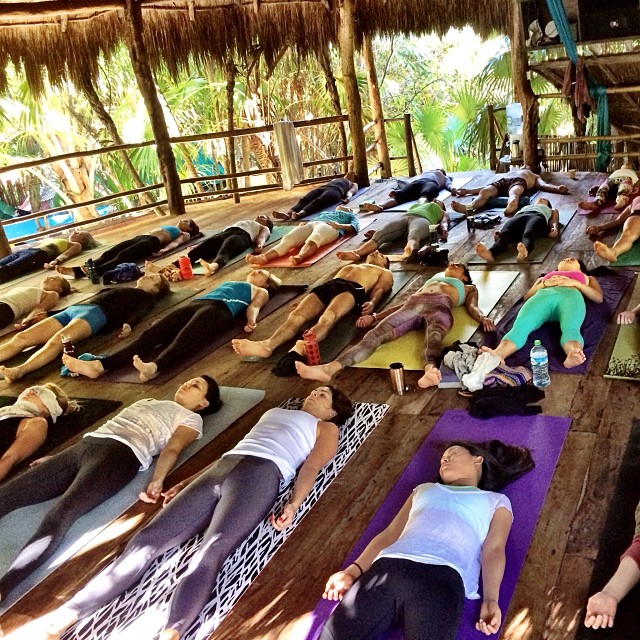
At the end of every yoga practice, it is custom to wind down and let go of all the work, the concentration, the effort, the sweat, and settle into a position of total relaxation: savasana. You are typically advised to take a minute or two to allow yourself to fall into this restorative position and release everything you’ve been holding up until that time. While it looks like you are simply laying down, it can actually be quite difficult to settle completely, let go of everything, move away from your ujjayi breath and fall into an empty mind.

Regardless of the day I had, the people I’ve interacted with, the location of the studio, the teacher, the fellow yogis, my immediate worries or excitements, the songs playing, I always have the same free minded dreams. In every single savasana when I truly empty my mind and let myself just be, I am dancing. I am free in a meadow, in the sun, in a white dress, dancing. By myself and soaking up the world around me, I am dancing.

It is such a freeing experience that I strongly dislike being pulled away from by the sound of a voice letting us know that it is time to bring awareness back into our bodies. I love a savasana especially when proper time is given for your body to embrace it fully. It makes me wonder if others experience the same feelings, the same escape. So, I close with a question: what is your savasana?

savasana

Photo credit: Rachel Brathen. If you’re looking for inspiration in yoga, fitness, or just life in general, check her out. She’s a wonderful carefree spirit who is constantly seizing life and living in the moment. Her Instagram is an especially inspiring daily boost: @Yoga_Girl.